 English
 简体中文
简体中文
 عربي
عربي
 Dansk
Dansk
 Deutsch
 Русский язык
 Français
 Pilipino
 suomi
suomi
 한국어
한국어
 Malay
Malay
 Afrikaans isiXhosa
 Zulu, eNingizimu Afrika
 Português
 日本語
日本語
 Svenska
 ภาษาไทย
 Español
 Italiano
 IndonesiaName
 Tiếng Việt

Every month, fleet managers across the world sign off on SIM card bills that are quietly two or three times higher than they need to be. The SIM vendors are pleased. The hardware manufacturers are unbothered. And the firmware engineers who wrote the bloated protocol stack are long gone.
This is a breakdown of how much data a GPS tracker actually consumes, why the real number is shockingly low, and what is inflating the bill on your end.
The Ambush at Month-End
The scenario is familiar: finance drops an overuse invoice on your desk. Your fleet of GPS trackers has blown through its standard 30 MB SIM plan. The vendor's account manager calls with a helpful suggestion — upgrade each device to a 50 MB pooled plan. Single-unit price comes down a little. You do the math on ten thousand units and sign.
The assumption behind that decision — that a tracker reporting position every few seconds legitimately needs 50 MB a month — is false.
The real number: A GPS tracker doing nothing but transmitting coordinates, running on factory default settings — no video, no audio, no rich telemetry — consumes well under 30 MB per month on a heavy-duty truck running eight hours a day. In many real deployments, the figure is closer to 8–12 MB.
Factory defaults on a well-engineered device look like this: position reported every 20 seconds while moving; a low-overhead heartbeat packet sent every 5 minutes at rest, maintaining the last known location without triggering a full GPS cycle. When the vehicle is parked, data consumption drops to near zero.
Customers can and should adjust reporting frequency to match their operations. But the starting point for those conversations should be 30 MB, not 50 MB. The difference, across a large fleet, is not trivial.
Where the Overhead Actually Comes From
The inflated bills are not random. They trace back to two compounding problems in how GPS hardware is typically built and sold.
1. The TCP Handshake Tax
Many low-cost GPS devices are hardcoded to use TCP for all communication. TCP is a reliable protocol — but reliability has a cost.
To deliver a single position payload, a TCP device must first complete a three-way handshake (SYN → SYN-ACK → ACK). Once the data is sent, the server issues an acknowledgment. On a network with any instability at all — a tunnel, a rural dead zone, a brief signal fade — TCP's retransmission logic kicks in automatically and starts resending.
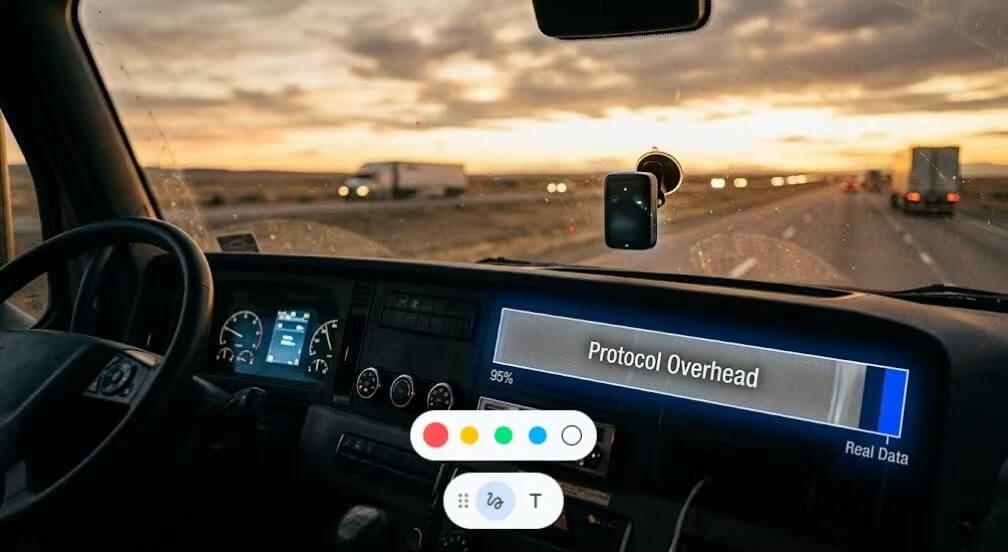
The arithmetic is brutal: the actual position payload might be 50 bytes. The protocol overhead surrounding that 50 bytes can consume 300 bytes or more. You are paying for a five-ton armored truck to deliver a five-gram letter.
2. TCP vs. UDP: The Choice You Were Never Given
The two protocols serve different use cases, and neither is universally better.
UDP is a connectionless protocol. The device transmits and moves on — no handshake, no acknowledgment, no persistent link. This makes it extremely data-efficient and fast to respond. The trade-off is resilience: in poor signal conditions, packets can be lost, and you get gaps in tracking. UDP is the right choice for wireless, battery-powered devices — asset trackers, portable tags, equipment monitors.
TCP maintains a persistent connection. A heartbeat packet keeps the link alive every five minutes; the moment the device detects motion, it switches to active reporting. Data integrity is strong even in patchy coverage. The cost is the baseline overhead of keeping that connection open. TCP suits wired devices with a stable power source — hardwired vehicle trackers, OBD-II plug-ins, commercial fleet terminals.
The problem is not the protocol itself. The problem is that many manufacturers make this choice for you, lock it in firmware, and then allow SIM vendors to profit from the consequences.
The Quiet Alliance Between Hardware Makers and SIM Vendors
This is not a conspiracy. It is a set of misaligned incentives that produce a predictable outcome.
Hardware manufacturers take the path of least resistance. Firmware built on standard GT06 (dominant in export markets) or JT/T 808 (the Chinese national standard) is fast to develop and easy for customers to integrate. Transmitting in plain JSON or ASCII text means any platform can parse it out of the box. Development costs stay low. Data costs get passed to the end customer. The manufacturer collects payment and ships the units.
The manufacturers with a genuine edge — particularly those building on the advanced manufacturing infrastructure of Shenzhen — go further. OEM and ODM programs, proprietary protocol compression, integration with customer ERP or dispatch systems: these are the value-add services that return control of communication costs to the operator. They require more engineering investment. They are also how a vendor differentiates itself from the commodity tier.
SIM vendors benefit from bloated consumption. A device that burns 45 MB a month is a 50 MB plan sale. A device that burns 12 MB is a 30 MB plan sale — or a lost upsell. The incentive to push customers toward higher-tier plans is structural. Protocol selection is a commercial decision dressed up as a technical one.
The Veyloc Approach: Engineering for Efficiency
At Veyloc, we treat data consumption as a design constraint, not an afterthought.
Cornering Algorithm (dynamic upload logic): A truck driving a straight 10-kilometer stretch on a highway generates the same position data whether you sample it every 10 seconds or every 60 seconds — because nothing is changing. Our firmware uses angular change rate and dynamic distance calculation to determine when a data point is actually informative. On straight runs, transmission frequency drops. Through turns, it increases. The result: 60% fewer packets with no degradation in track quality.
UDP with application-layer acknowledgment: For high-frequency reporting requirements, we support UDP with our own lightweight packet-loss detection built at the application layer. This eliminates TCP handshake overhead entirely while preserving delivery reliability — the best of both protocols rather than a default choice between them.
The combination means our customers routinely run well-engineered devices on 30 MB plans, even in demanding operational environments.
Four Questions to Ask Before Your Next Purchase
Use these at your next vendor evaluation. The answers will tell you whether you are buying efficient hardware or buying someone else's margin.
'Is this device wireless or wired? Can parameters be changed remotely via SMS or platform command?'
Hardwired devices must support remote parameter changes through both SMS and platform — including APN, reporting interval, and heartbeat timing. If settings are locked at the factory, you have no control over your operating costs. Walk away.
'What are the factory default reporting settings? How often does it transmit while moving, and what happens when the vehicle is stationary?'
The correct answer: position reported every 20 seconds while in motion; heartbeat packet every 5 minutes at rest. A vendor who cannot answer this question — or whose defaults push aggressive sampling — is building your bill into the product specification.
'What communication protocol does the device use? Does it support UDP?'
For wireless devices: TCP-only firmware means structurally inflated data usage. For wired devices: if TCP is used, confirm the heartbeat interval is configurable. A vendor who cannot discuss this is not operating at the firmware level.
'Does the device have a built-in cornering algorithm or direction-change-triggered dynamic upload logic?'
Without this, the device is transmitting at a fixed interval regardless of whether the vehicle is moving, turning, or sitting in a parking lot. Every unnecessary packet is a fraction of a cent. Across a large fleet, those fractions add up to real money.
The Bottom Line
A GPS tracker's job is to tell you where a vehicle is. That information, on a well-engineered device with sensible defaults and the right protocol for the application, costs less than 30 MB a month to transmit.
The gap between 30 MB and 50 MB is not physics. It is firmware, protocol choice, and vendor incentive — all of which are negotiable, if you know which questions to ask.




















 Tansy
Tansy

