 English
 简体中文
简体中文
 عربي
عربي
 Dansk
Dansk
 Deutsch
 Русский язык
 Français
 Pilipino
 suomi
suomi
 한국어
한국어
 Malay
Malay
 Afrikaans isiXhosa
 Zulu, eNingizimu Afrika
 Português
 日本語
日本語
 Svenska
 ภาษาไทย
 Español
 Italiano
 IndonesiaName
 Tiếng Việt

It starts with a temperature reading that nobody checked.
The battery management system logged the anomaly. The data was there. It sat inside the battery — untransmitted, unmonitored — until the thermal event stopped being a data problem and became a physical one. By then, what the data said didn't matter anymore.
Electric two-wheelers are the engine of last-mile commercial delivery across Asia-Pacific. They carry food orders, parcels, and grocery deliveries through streets that larger vehicles can't navigate. Delivery platforms run on them. Independent riders operate them. They charge in residential buildings. They park in corridors and stairwells.
Battery fires in those buildings are not hypothetical. They're documented. Recurring. The data to predict them exists inside the battery. The infrastructure to get that data out, transmit it, and act on it before a fire starts — that's what was missing.
THE CLIENT
A fleet operations and safety management organization running a mixed portfolio of commercial delivery e-bikes and civilian electric two-wheelers across multiple cities. They serve both commercial delivery platforms and individual users.
They came in with two problems that looked separate. They weren't.
TWO PROBLEMS. ONE ROOT CAUSE.
Problem one: Fire risk that was invisible until it wasn't.
Every electric two-wheeler in the fleet had a Battery Management System — a BMS continuously tracking cell temperature, voltage, charge cycles, and fault states. The data existed. The problem was that it stayed inside the battery. Nothing extracted it, transmitted it to a monitoring platform, or turned it into an alert before a dangerous condition became an incident.
A battery running dangerously hot at midnight, charging in a building hallway, was completely invisible to the operator — until it wasn't.
Problem two: Operational chaos that manual oversight couldn't fix.
The fleet mixed commercial delivery vehicles — registered to delivery platforms, operated by contracted riders, supposed to follow defined routes and charging rules — with civilian vehicles operating under entirely different patterns.
On the ground, they were indistinguishable. Commercial vehicles got left in places they shouldn't be. Civilian vehicles charged in elevators and building lobbies. Stolen vehicles kept running across the city, because cutting the physical lock on a standard e-bike takes four minutes and produces a fully working vehicle.
The existing monitoring — to the extent there was any — couldn't tell the difference between a delivery vehicle that should be moving and one that had been abandoned. Couldn't distinguish a vehicle charging in an approved location from one creating a fire hazard in a stairwell. Couldn't identify a vehicle in authorized use from one in the hands of whoever had cut the lock.
Both problems traced back to the same gap: the data inside the battery and the data about where the vehicle was had no path to the people who needed to act on it.
THE DEVICE THAT CLOSES THE GAP
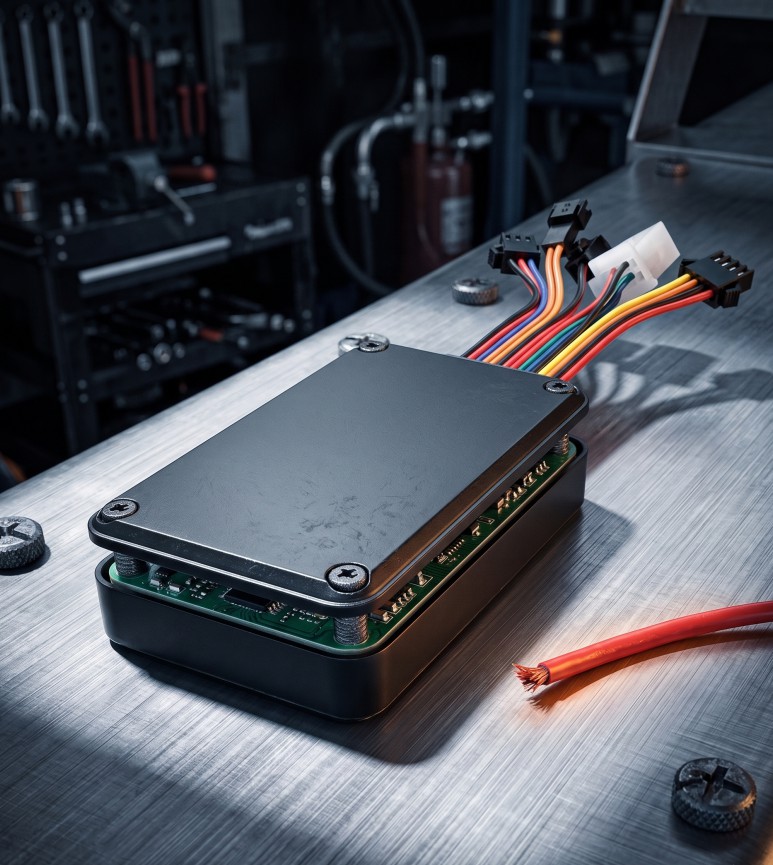
The solution required building something that didn't exist as a standard product: a single unit combining a 4G communication terminal with a direct BMS data interface — the Battery 4G BMS-Integrated Terminal.
The reasoning behind combining these two functions matters.
Separate devices for BMS monitoring and location tracking mean two independent data streams, two separate power draws, two maintenance points, and two different failure modes. On a commercial delivery e-bike — outdoor use, high daily mileage, varied charging environments — every additional component is an additional failure point. One integrated unit changes the reliability math.
What the device had to do:
Pull BMS data directly via RS-485 Modbus RTU — the native communication protocol the battery's BMS uses internally. This isn't a consumer-facing interface. It requires the device to speak the battery's own language.
Transmit continuously over 4G while managing power consumption carefully. A device that drains the battery it's monitoring creates a different problem. Sleep current had to stay below 15mA, with wake-on-command capability so the platform could pull data or issue instructions even while the terminal was in low-power mode.
Handle the BMS wake cycle correctly. When the terminal needs to communicate with the BMS during sleep, the WK pin activates the BMS, completes the data exchange, and immediately drops back to low. An implementation that leaves the WK pin active causes continuous BMS activation — a power drain and a potential hardware damage scenario.
Locate the vehicle across every signal environment. Vehicles travel through parking garages, tunnels, and under bridges — environments where GPS alone regularly fails. The terminal integrates GPS, LBS cell tower triangulation, Wi-Fi positioning, and AGPS into a single location stack built into the BMS control board, automatically shifting between methods based on current signal strength. The result is accurate, continuous positioning whether the vehicle is on an open road, underground, or in a signal-shielded area.
Lock the motor on command. Not a software lock that a factory reset bypasses. A hardware-level motor lock — triggered by platform command or automatic anomaly detection — that cuts power and prevents the vehicle from starting. The physical frame lock is a separate matter. The motor lock addresses what happens after it.
Run dual-protocol, dual-platform architecture. Primary platform communication runs on JT808 — the transport data standard — handling full data transmission, remote parameter configuration, and over-the-air firmware updates for both the terminal and the BMS board. Secondary platform communication runs on MQTT transparent transmission, carrying only location and BMS data for fast, lightweight delivery to monitoring interfaces.
HOW IT WORKS IN THE FIELD
Stopping fires before they start:
The terminal reads BMS data continuously — cell temperature, voltage, charge state, fault codes. The monitoring platform runs these against threshold models. When a cell temperature climbs outside the normal operating range during charging, the platform generates an alert before the condition has a chance to escalate. The operator can cut power to the charging circuit remotely and dispatch a technician before a thermal event occurs.
The data was always there. Now it has somewhere to go.
Telling commercial from civilian:
Every terminal carries a commercial or civilian identifier. Commercial delivery vehicles — operating for food delivery and instant retail platforms — are tracked against route data, delivery frequency, and battery utilization. Civilian vehicles run under separate monitoring rules focused on parking compliance and charging location.
A commercial vehicle that hasn't moved in four hours during a delivery window gets flagged for investigation. A civilian vehicle whose GPS puts it inside a building elevator shaft triggers a parking compliance alert. The system differentiates because the terminal identifiers differentiate.
Recovering stolen vehicles:
When a tamper event is detected — abnormal handling, lock cutting, unauthorized movement — the terminal issues a motor lock command. The vehicle stops. Its location transmits to the platform in real time. Operators can use the precise coordinates to locate and recover the vehicle quickly, keeping asset losses to a minimum.
Optimizing commercial delivery operations:
Route data from commercial delivery terminals feeds back to the operating platform. Actual routes, actual timing, actual battery consumption per route segment. The platform can match vehicles to routes based on available charge, reduce unnecessary battery swaps, and flag route segments where battery drain is abnormally high — pointing to either routing inefficiency or battery degradation.
FOUR THINGS BMS INTEGRATION MAKES POSSIBLE
Smarter battery resource management. Real-time BMS data tells operators exactly where every battery stands — health, remaining charge, wear level. Swap schedules, charging plans, and maintenance cycles stop running on fixed timetables and start running on actual battery condition. Which batteries can handle another run. Which ones need to come out now. Network depot stock levels and rotation schedules optimize continuously, cutting idle inventory and unnecessary costs.
Data-driven commercial operations. For platforms running hundreds of delivery vehicles, every operational decision needs data behind it. Route efficiency, battery utilization, rider behavior, swap frequency — previously these could only be estimated. The BMS terminal makes them measurable, trackable, and improvable. Data-driven operations aren't the goal. They're the mechanism that keeps margins moving in the right direction.
Catching thermal runaway before it happens. Battery fires don't come out of nowhere. They have a data trail — temperature anomalies, voltage fluctuations, overcharge conditions that appear hours before a thermal event, sometimes earlier. With BMS data streaming to the cloud and alert models running continuously, operators get a warning when something is wrong, not a phone call after something has burned. That's the difference between a maintenance dispatch and an insurance claim.
Asset protection across the full lifecycle. From battery health to vehicle location, from charging compliance to motor lockdown, the BMS-integrated terminal pulls everything that affects asset safety into one platform. Commercial operators know where every vehicle is, what condition it's in, and whether it's at risk. Individual users get an immediate alert the moment something looks wrong. Asset protection stops depending on luck and starts depending on data.
WHAT CHANGED
Before | After | |
Battery fire risk | BMS anomaly data stays inside the battery. No transmission path. Fire risk is invisible until thermal runaway occurs. | BMS data streams continuously. Anomalies trigger real-time alerts before escalation. Remote charging cut-off available immediately. |
Vehicle theft | Physical lock cut = working vehicle. Recovery means tracking a moving vehicle with no location data. | Motor lock triggers on tamper detection. Stolen vehicle can't move. GPS + LBS + Wi-Fi + AGPS location fixed and transmitted for rapid recovery. |
Commercial vs. civilian visibility | Fleet indistinguishable on the ground. No operational classification. | Terminal-level identifiers. Separate monitoring rules, alert thresholds, and compliance requirements per vehicle type. |
Parking and charging compliance | No way to detect unauthorized parking or corridor/elevator charging without physical inspection. | GPS monitoring with geofencing alerts for non-compliant parking and charging locations. |
Commercial delivery efficiency | Route and battery data unavailable to platform. Dispatch based on scheduling, not vehicle state. | Real-time route and battery utilization feeds platform dispatch optimization. Swap scheduling based on actual charge state. |
Data redundancy | Single-platform transmission. No layered backup. | Dual-protocol dual-platform architecture. JT808 primary handles full data and remote upgrades. MQTT secondary handles core data fast path. |
Remote management | No OTA capability. Firmware updates require physical access to the vehicle. | Full OTA for terminal firmware and BMS board. Parameter configuration and firmware deployment without retrieving the vehicle. |
THE NUMBER THAT MATTERS TO A CFO
Battery fires in commercial delivery fleets generate costs across three categories that rarely sit on the same spreadsheet: asset replacement, liability from property damage or personal injury, and platform penalty clauses triggered by delivery disruptions from fleet incidents.
Monitoring doesn't eliminate battery failure. Batteries fail. What changes is the detection window — from zero warning to early anomaly detection — and the response window — from post-incident investigation to pre-incident intervention.
The per-vehicle cost of the terminal and monitoring infrastructure is a fixed number. The cost of one undetected thermal event in a residential building is not.
For delivery platform operators, the efficiency math runs differently:
Battery swap frequency is a direct operating cost. A fleet running on scheduled swap intervals swaps batteries that don't need swapping and runs batteries that do need swapping too long. Real-time BMS data changes that calculation. Across a fleet of hundreds of vehicles, the optimization compounds per route, per day.
THE QUESTION FLEET OPERATORS CAN'T STOP THINKING ABOUT
Every operator running a mixed fleet of commercial and civilian electric vehicles is managing some version of the same risk: a vehicle they're responsible for is charging somewhere they didn't authorize, in a condition they can't see — and the first sign that something went wrong will be a phone call.
The BMS has been recording the data that would have predicted it. It just had nowhere to go.
GET THE TECHNICAL DETAILS
For engineering and implementation teams: Download the Veyloc Battery 4G BMS-Integrated Terminal Technical Specification Includes RS-485 Modbus RTU protocol implementation, WK pin BMS wake cycle documentation, dual-protocol JT808/MQTT architecture spec, and motor lock circuit configuration. → [Download Terminal Technical Spec Sheet (PDF)]





















 Tansy
Tansy

