 English
 简体中文
简体中文
 عربي
عربي
 Dansk
Dansk
 Deutsch
 Русский язык
 Français
 Pilipino
 suomi
suomi
 한국어
한국어
 Malay
Malay
 Afrikaans isiXhosa
 Zulu, eNingizimu Afrika
 Português
 日本語
日本語
 Svenska
 ภาษาไทย
 Español
 Italiano
 IndonesiaName
 Tiếng Việt

VEYLOC | FLEET INTELLIGENCE SERIES
The Blind Spot Costing Fleets Millions
Most modern fleet managers have real-time visibility into every truck cab. But the moment a $40,000 trailer is unhitched at a remote drop yard — or a shipping container loaded with high-value cargo disappears into an intermodal network — it instantly becomes a blind-spot asset: a high-value piece of equipment that your telematics platform simply cannot see.
The operational consequences are well-documented: equipment theft, chronically underutilized trailers, and spoiled refrigerated cargo that triggers six-figure insurance claims. In 2026, a manual yard walk-around is no longer a credible answer. The question every operations director is asking is the same:
“How do we get the same real-time visibility over our trailers and containers that we already have over our truck cabs — without rewiring our entire fleet?” |
This guide breaks down why standard vehicle trackers fail on unpowered assets, objectively compares the three dominant tracking technologies, and defines the non-negotiable hardware standards for industrial-grade deployment.
What Counts as a Non-Vehicle Asset?
Unlike a motorized cab with a continuous 12V or 24V power supply and an OBD-II diagnostic port, non-vehicle assets — also called unpowered assets — operate completely off the grid once detached. The most operationally critical categories include:
• Trailers: Dry vans and flatbed trailers — constantly exchanged between third-party drivers, brokers, and logistics partners, often left at unmanned drop yards for days or weeks.
• Shipping containers: ISO shipping containers moving across borders, ports, rail yards, and intermodal hubs in journeys that can span multiple weeks and several countries.
• Heavy construction equipment: Generators, light towers, compressors, and excavators left on unsecured job sites — high-value, low-visibility, and a prime target for theft.
What all three have in common: no power source, no OBD port, and no tolerance for a tracking device that needs weekly recharging or a technician for installation.
Why Standard Vehicle Trackers Fail Here
Before evaluating hardware options, it is worth understanding the three fundamental reasons why a standard hardwired fleet tracker — effective as it is on a powered vehicle — is structurally unsuitable for unpowered assets.
1. No Available Power Source
A hardwired tracker draws power from the vehicle’s electrical system. Disconnect it from the cab and it dies. A tracker deployed on an unpowered asset must run entirely on internal battery — not for days, but for months or years — without any opportunity to recharge in the field.
2. Extreme Environmental Stress
Trailers and containers are subjected to conditions that would destroy consumer-grade electronics: sustained sub-zero temperatures, salt spray from ocean transit, mechanical shock from rail coupling, and UV degradation from months of open-yard exposure. Enclosures need to meet verified industrial standards, not marketing claims.
3. Cross-Border Cellular Continuity
Real-world scenario: A container loaded with automotive components leaves a factory in Monterrey, Mexico. It crosses into Laredo, Texas, transfers to a rail network, and arrives at a distribution hub in Chicago — a multi-week journey across two countries and three carrier networks.
Throughout that journey, the tracking device must autonomously switch between national carriers without any manual intervention, ensuring the logistics operator sees a single, uninterrupted location trail in their backend platform. |
A tracker locked to a single carrier SIM will go dark the moment it crosses a border. Multi-carrier or eSIM-based devices are not optional for cross-border operations — they are a baseline requirement.
Technology Comparison: RFID vs. Bluetooth vs. 4G GPS
Operations and procurement teams frequently evaluate all three technologies when scoping an asset tracking project. Here is an objective breakdown:
Criteria | RFID | Bluetooth (BLE) | 4G LTE-M / NB-IoT GPS |
Coverage Range | < 10 meters | Up to 100 meters | Unlimited / Global |
Infrastructure Required | Fixed readers + tags | Gateway hubs / mobile app | None — direct to cell tower |
Scales with Distance | Cost multiplies | Coverage gaps | Flat cost, any location |
Works Off-Grid / Remote | No | No | Yes |
Best Use Case | Indoor warehouse inventory | Short-range yard management | Field, intermodal, cross-border |
RFID (Radio Frequency Identification)
RFID remains the gold standard for indoor warehouse inventory — cycle counting, inbound/outbound dock management, and ERP integration. The system forms a closed loop between fixed readers and passive tags, with strong support for real-time stock visibility and relatively low long-term maintenance costs. Its critical limitation is physical: effective read range tops out at under 10 meters, and extending that range requires additional fixed infrastructure whose cost scales multiplicatively with distance. For an asset parked in an open yard 500 meters from your nearest reader, RFID offers nothing.
Bluetooth Low Energy (BLE)
BLE is a practical solution for localized yard management — tracking assets within the footprint of a depot or distribution center where gateway hubs or staff smartphones provide consistent coverage. The technology’s fundamental constraint is its MAC address resolution model: a BLE device continuously scans for known Bluetooth addresses within range. The moment an asset moves outside gateway coverage, the device enters a persistent scan loop and location reporting stops entirely. For assets that leave the yard, BLE provides no visibility.
4G LTE-M / NB-IoT GPS — The Fit for Unpowered Assets
For assets that travel beyond the perimeter of a single facility, cellular-connected battery-powered GPS trackers are the only technology that delivers autonomous, wide-area tracking without secondary infrastructure. Leveraging LPWAN (Low-Power Wide-Area Network) technology, these devices transmit directly to global cell tower networks. There is no gateway, no hub, no secondary device required. The tracker wakes, acquires a fix, transmits coordinates, and returns to sleep — all on internal battery power.
Hardware Selection: The Non-Negotiable Standards for 2026
Choosing an asset tracker is not a commodity procurement decision. The wrong hardware choice results in devices that fail in the field, require costly reinstallation, or create liability gaps in your tracking coverage. Here are the three criteria that separate industrial-grade hardware from the rest.
1. Battery Capacity and Intelligent Power Management
Battery life is not a spec-sheet number to be compared in isolation — it is the operational lifespan of your deployment. A device that needs retrieval for recharging every six months on a trailer fleet of 200 units creates a significant ongoing labor cost that most procurement teams fail to model upfront.
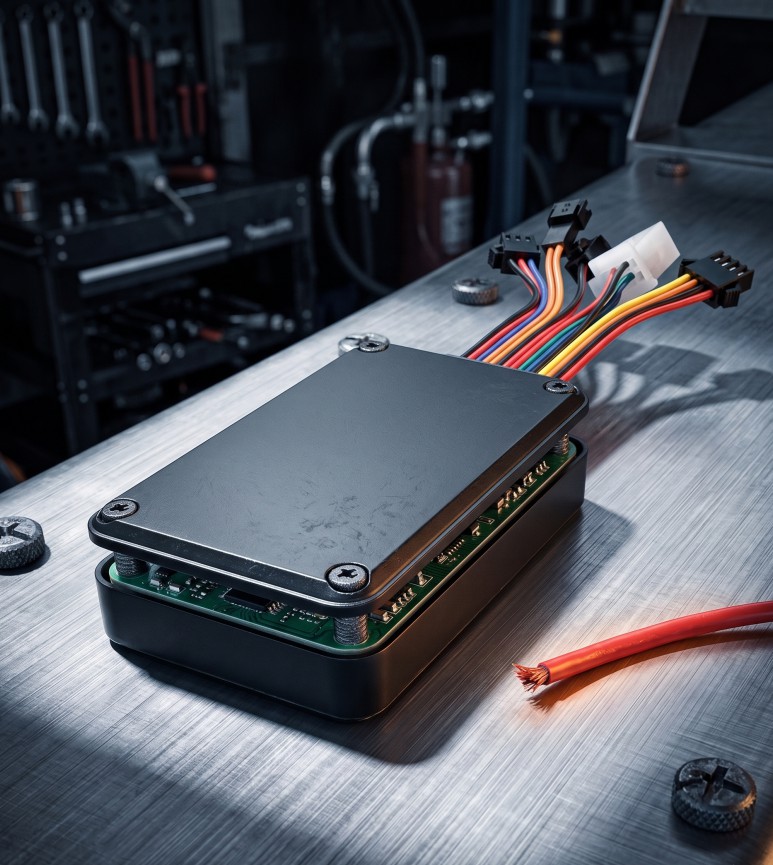
The Veyloc VA20 addresses this with an industry-leading 20,000mAh high-capacity battery designed for multi-year autonomous operation. Power efficiency is managed by an integrated G-SENSOR: the device enters an ultra-low-power sleep state when stationary and wakes immediately upon detecting movement, transmitting precise GPS coordinates before returning to sleep. The result is a battery profile optimized for assets that spend the majority of their time idle.
2. Industrial-Grade Durability and Zero-Downtime Installation
The enclosure standard matters. IP67 certification — meaning full dust ingress protection and submersion resistance to 1 meter — is the baseline for outdoor industrial use. Devices deployed on ocean containers or in northern climates during winter should meet IP68.
Beyond the enclosure, installation speed is a hidden cost that compounds at scale. A device requiring drilling or hardwiring takes 20–30 minutes per asset and creates vehicle downtime. The VA20’s heavy-duty magnetic mount attaches to any metal surface in seconds with no tools, no wiring, and no asset downtime. On a 500-unit trailer fleet, that installation time difference translates directly to project deployment cost.
On compliance: Veyloc hardware incorporates cellular modules sourced from globally certified vendors, with devices designed to meet PTCRB, FCC, and CE compliance requirements. For OEM partners and system integrators pursuing local type approval, Veyloc provides pre-compliance laboratory reports and hardware schematics to accelerate the certification process under your own brand.
3. Open API and Platform-Agnostic Integration
The first question any experienced system integrator asks about a new hardware device is not about the tracker — it is about the integration pathway. How quickly can this device talk to our existing telematics platform?
Veyloc hardware supports MQTT and major telematics communication protocols over TCP/UDP transport, with fully documented APIs. This ensures compatibility with leading platforms including Wialon, Navixy, and custom ERP environments, significantly reducing software development time for integration projects.
Eliminating Your Fleet’s Blind Spots
Tracking unpowered assets is no longer a technical challenge — it is a procurement and partnership decision. The technology exists. The question is whether your hardware supplier can deliver industrial-grade reliability, verifiable compliance credentials, and the supply chain flexibility that large-scale deployments demand.
By sourcing factory-direct from Veyloc, system integrators and fleet operators eliminate intermediary markups, gain direct access to engineering support, and accelerate deployment timelines on projects of any scale.
Ready to eliminate your blind spots? Take the next step:
Step 1: Download the 2026 Industrial Asset Tracking Datasheet Compare full technical specifications, battery life benchmarks, API documentation, and hardware dimensions for the VA20 and VA08-Temp product lines. |
Step 2: Contact the Veyloc Engineering Team Request a custom deployment plan and factory-direct wholesale pricing for your project. |





















 Tansy
Tansy

