 English
 简体中文
简体中文
 عربي
عربي
 Dansk
Dansk
 Deutsch
 Русский язык
 Français
 Pilipino
 suomi
suomi
 한국어
한국어
 Malay
Malay
 Afrikaans isiXhosa
 Zulu, eNingizimu Afrika
 Português
 日本語
日本語
 Svenska
 ภาษาไทย
 Español
 Italiano
 IndonesiaName
 Tiếng Việt

In this industry, the biggest irony is spending money on a fleet management system to save cash, only to watch it suck your budget dry.
Many fleet managers install trackers to monitor 'harsh braking' and 'aggressive acceleration' for insurance telematics discounts. But they don't realize those cheap $20 boxes are lying to God and the insurers in the background.
Today, we break down the crappy physics behind Driver Behavior Analysis (DBA).
The 'Premium Hike' Surprise
This is the most awkward scene at fleet insurance renewals every year:
You're in the broker's office, expecting a 15% safe-driving discount because you equipped all trucks with GPS trackers.
But the report shows your fleet triggered 5,000 'harsh braking' and 3,200 'aggressive cornering' events last year. Premiums don't drop—they jump 20%.
You storm the dispatch room to grill drivers, but your 20-year veteran swears he just slowed normally at a light—no slamming brakes.
The problem isn't the driver's foot. It's the dumb black box under the dash hallucinating normal driving as near-crashes.
The Root Cause: Lazy Math and Gravity Bleed
Why the flood of ghost 'harsh braking' alerts? Cheap trackers spit on physics.
- GPS-Based 'Fake Acceleration' Math
- 60% of budget devices lack a real G-sensor. They calculate braking with grade-school division: speed change over time.
In urban canyons, GPS signals drift (multipath error). One second you're at the intersection; next, a reflection makes it think you jumped back 10 meters. MCU calculates speed from 60 km/h to 0—bam, a 1.5g 'harsh brake' alert.
Using GPS for braking is like eyeballing stars to measure cosmic expansion: ridiculous.
- Uncalibrated Axis Mess (Gravity Bleed)
- Better ones have 3-axis accelerometers, but installation angles wreck them. Techs zip-tie trackers at 30° or 45° for hiding. Earth's 1g gravity pulls down, but tilt 'leaks' it into forward (Y) or side (X) axes.
Result: 0.5g baseline noise even when parked. A light tap on brakes (0.2g) plus noise hits 0.7g threshold. Your drivers hit the road, and the system thinks they're racing.
The Trap: The Software 'Gimmick'
Integrators love blaming 'platform algorithms.'
When you complain about too many alerts, support says: 'We'll bump the threshold higher in the web backend.'
That's lazy cover-up. Cloud-jacking from 0.5g to 0.8g cuts fakes, but misses real crashes or rear-ends.
Hardware errors at the physical layer can't be patched with cloud band-aids.
The Veyloc Standard: Edge Computing and Auto-Calibration
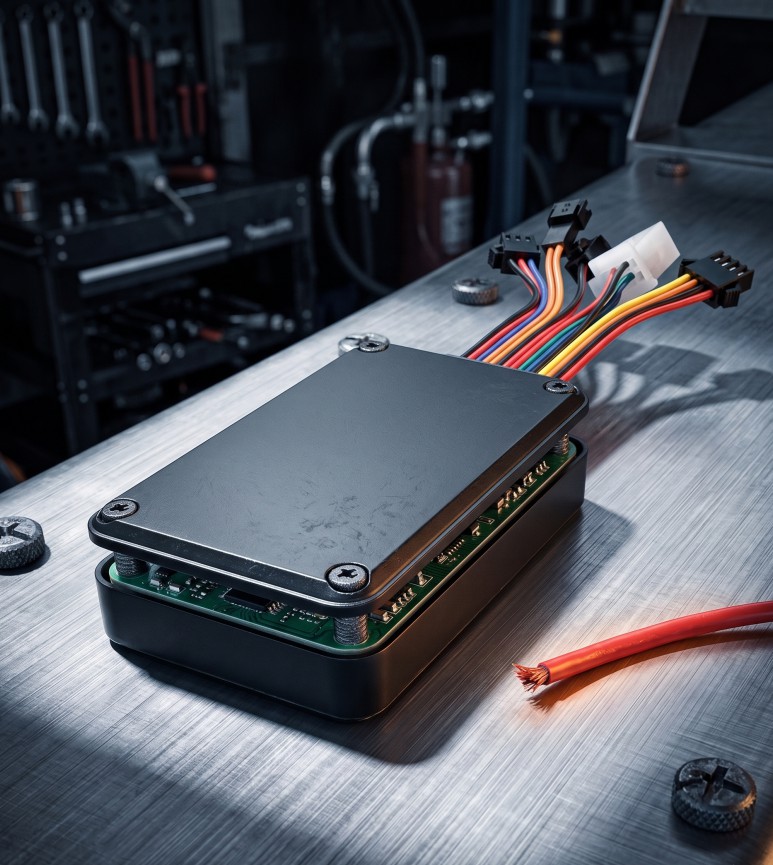
At Veyloc, we handle driver data with edge computing rules: Clean junk at the hardware level.
- 6-Axis Auto-Calibration: Veyloc units (like V8 series) self-calibrate post-install. First 10 minutes on-road, MCU uses Doppler vectors and high-precision sensors to matrix-transform tilt back to true vehicle axes. No matter how crooked the install, Y-axis always points forward.
- 100Hz Edge Sampling: Cheap ones read G-sensor once per second. We sample at 100Hz inside the MCU, low-pass filtering out engine rumble.
- Duration Check: A pothole spike (2g instant) isn't braking. Firmware requires threshold breach (e.g., 0.4g) plus hundreds of milliseconds sustained to flag aggressive driving.
The 'BS Detector' Checklist
Don't let cheap hardware tank your insurance deals. Slam these questions on the table next purchase:
- 1.'Is harsh braking from GPS speed diffs or dedicated G-sensor hardware?' (GPS? Blacklist them.)
- 2.'Auto-calibration for install tilt, or manual level-tool tweaking?' (No auto? Useless on trucks.)
- 3.'What's the chip-level G-sensor sampling rate? Duration validation for bumps?' (Separates real R&D from knockoff factories.)



















 Tansy
Tansy

