 English
 简体中文
简体中文
 عربي
عربي
 Dansk
Dansk
 Deutsch
 Русский язык
 Français
 Pilipino
 suomi
suomi
 한국어
한국어
 Malay
Malay
 Afrikaans isiXhosa
 Zulu, eNingizimu Afrika
 Português
 日本語
日本語
 Svenska
 ภาษาไทย
 Español
 Italiano
 IndonesiaName
 Tiếng Việt

The 'Green Death' Scenario
You send an excavator to a job site. To make installation easy, the technician slaps a magnetic GPS tracker onto the chassis beam. The spec sheet proudly claims “IP65 waterproof.”
The machine works all day under blazing sun and a hot engine. By evening, the tracker is scorching. The driver pulls into the wash bay and blasts the undercarriage with a high-pressure hose.
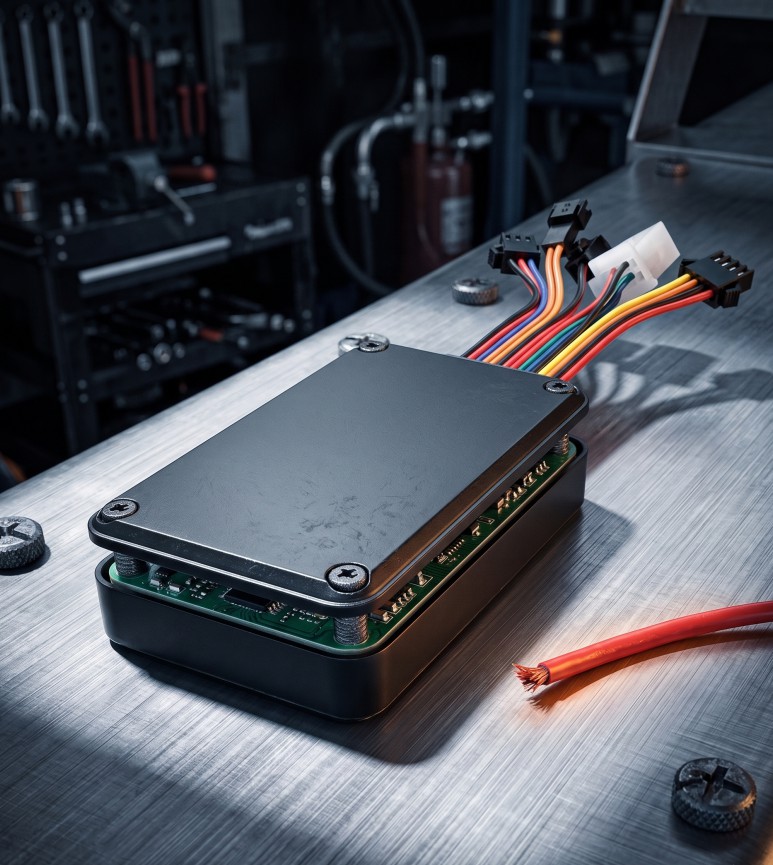
Next morning, the device is offline. You remove it, pry open the case—no obvious water inside, but there’s a burnt smell. The circuit board is covered in green corrosion (oxidized copper).
The salesman never told you: your tracker didn’t drown. It suffocated.
The Real Culprit: The Breathing Vacuum Effect
Most budget “waterproof” devices don’t fail because the seal leaks—they fail because of basic physics: temperature-driven pressure changes.
Heating phase: While running, the air inside the device expands. If the seal isn’t perfect, some air escapes.
Sudden cooling phase (the killer): Cold rainwater or car-wash spray hits the hot case. Internal air contracts rapidly.
Vacuum suction: This creates negative pressure inside. That vacuum is strong enough to suck water droplets through microscopic gaps in the seal.
This is called moisture ingress. For cheap devices without a proper breather vent, every hot-to-cold cycle acts like a piston pumping water vapor inside.
The Trap: IP65 Is Not Enough for Under-Vehicle Use
Many suppliers cut corners and blur the line between IP65 and IP67 to save money.
- IP65 (Water Jets): Protects against low-pressure jets. It usually relies on simple clips and basic rubber gaskets.
- IP67 (Immersion): Survives 1 meter underwater for 30 minutes. This is the real minimum for chassis-mounted trackers.
But even IP67 has a weakness: rubber plugs and caps age. USB port covers, dust caps, and soft rubber seals harden, crack, or fall off after months of mud, UV, and vibration. Once that happens, the device becomes an open water collector.
The Proper Fix: Veyloc’s “Gore-Tex” Approach
At Veyloc, we solve the pressure problem instead of just hoping the seal holds forever.
- ePTFE waterproof breathable membrane: Used in our V8 industrial series (same tech as Gore-Tex). It lets air molecules pass (0.0004 μm pores) while blocking larger water molecules. Internal pressure always equals external—no vacuum, no suction.
- Conformal coating on PCB: Military-grade protective lacquer sprayed on the board. Even if condensation forms inside, water beads up and rolls off without touching conductive pins. This is the last line of defense.
- Ultrasonic welding vs screws: For non-serviceable units, we ultrasonically weld the case shut—no seams at all. When screws are needed, we use 304 stainless steel with precise torque and sealant. We’ve seen too many rusty screws split housings; that’s amateur hour.
Your Buying Checklist: Questions to Ask Suppliers
Don’t trust the IP sticker on the box. Ask these three questions:
- 1.“Does your device have a waterproof breather vent to equalize internal/external pressure?” (If not, ask how they prevent vacuum suction during thermal shock.)
- 2.“Is the PCB coated with conformal coating?” (This is the only reliable protection against internal condensation.)
- 3.“If the case uses screws, what material are they and what’s the torque spec?” (If they can’t answer the torque value, their gasket compression is uncontrolled.)
Get honest answers—your fleet’s reliability depends on it.



















 Tansy
Tansy

